
Storytelling can reduce stigma. It can also reinforce it — here’s how to get it right
Stories are one of the most powerful tools we have to tackle stigma. They can challenge stereotypes, influence public opinion, humanise issues, and make invisible experiences visible. Done well, they can create the kind of connection that data alone rarely achieves.
But, done poorly, storytelling can also cause harm, reinforcing the very stigma it is trying to dismantle. Done poorly, storytelling can amplify stereotypes, expose people to harm, or reduce complex lives to simplified narratives. This is especially true when stories are rushed, extractive, or shaped to fit someone else’s agenda.
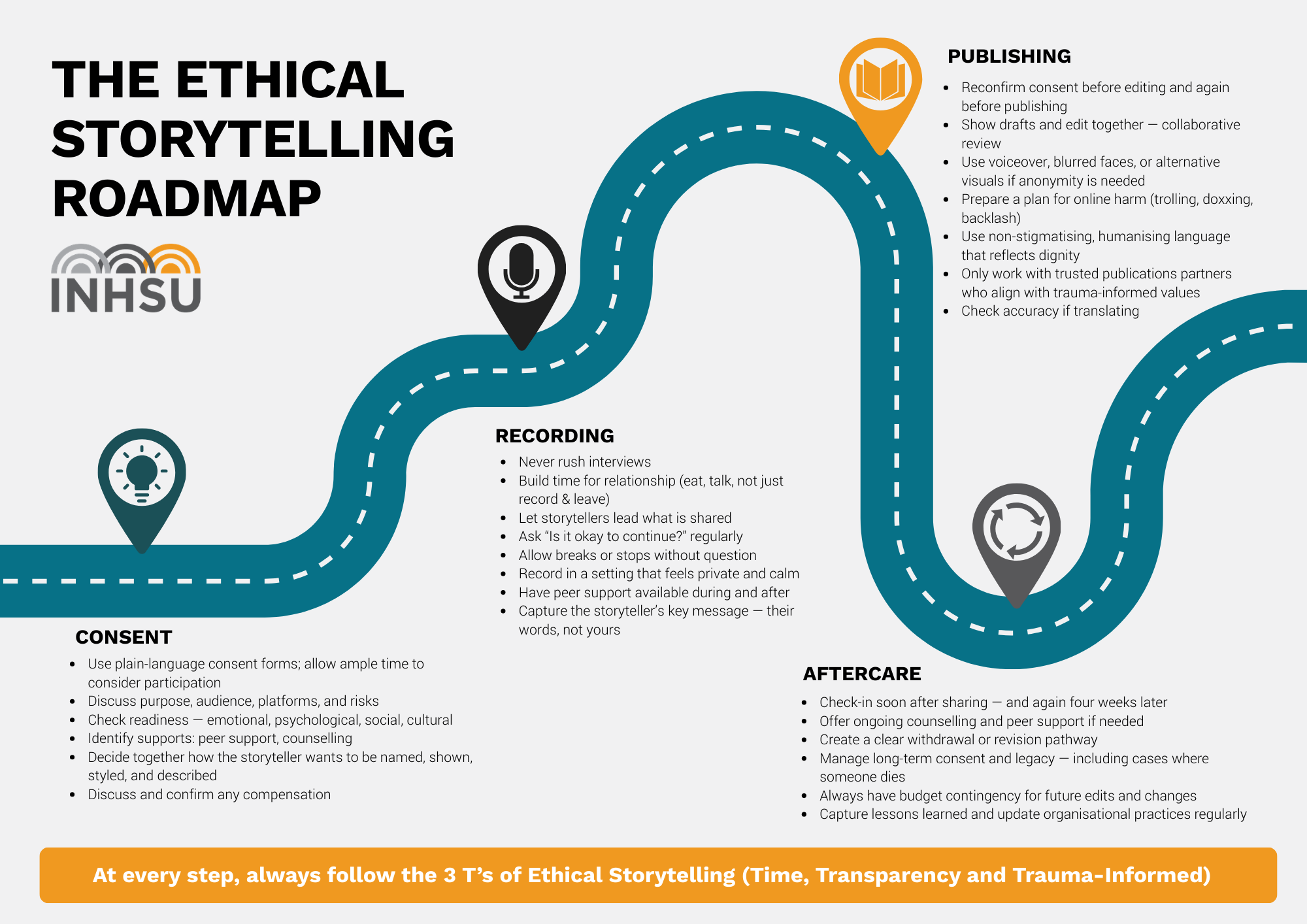
Brooke Nolan, Marketing and Communications Manager here at Tackling Stigma in Healthcare, also works at the International Network on Health and Hepatitis in Substance Users (INHSU), where she developed the Ethical Storytelling Roadmap, a practical framework co-designed with people with lived experience, community organisations, researchers, and practitioners.
Tackling Stigma founder Scientia Professor Carla Treloar was also involved in the design and development of the roadmap: with stories integral not just for communications and marketing, but also research.
While the roadmap was developed in the context of drug user health, its principles apply to anyone seeking or telling stories from stigmatised communities.
You can download the full roadmap here, or scroll down for seven key takeaways that consistently make the difference between harmful storytelling and ethical storytelling.
1. Don’t rush the story
Most harm in storytelling starts with time pressure. Ethical storytelling takes time. People need time to understand what they’re agreeing to, consider the risks, and decide whether they actually want to share.
Rushed timelines undermine consent.
In practice:
Give people days, not hours, to decide
Build breaks into interviews
Be prepared to delay publication
Accept that fewer stories told well is better than more stories that cause harm
If your timeline can’t accommodate this, the story probably shouldn’t happen yet.
2. Make consent real, not procedural
Consent is not a signed form. It’s an ongoing process.
People need to understand:
Why their story is being shared
Where it will appear
What could happen after it’s published
What support is available if things go wrong
And crucially, what support is not available.
As discussed in INHSU’s Ethical Storytelling Roadmap and launch webinar, harm can occur long after publication — including online abuse, loss of employment, housing issues, or being identified in ways people didn’t anticipate.
In practice:
Use plain language, not legal jargon
Reconfirm consent at multiple stages
Be explicit about risks, even uncomfortable ones
Make withdrawal a real option, not a symbolic one
If people don’t understand the downside, it’s not informed consent.
3. Let people lead their own story
A common failure point is when organisations come in with a pre-determined narrative and try to shape people’s experiences to fit it.
That’s extractive storytelling.
Ethical storytelling means being willing to change direction, or even abandon the story entirely, based on what people actually share.
In practice:
Ask open questions and follow where the conversation goes
Be prepared to scrap your original angle
Accept that the “strongest” story may not be the safest one to tell
Use only what aligns with what was agreed, not everything shared
A a large portion of what people share in an interview may never be used, and that’s often the right call.
4. Build relationships, not transactions
Ethical storytelling doesn’t start with a camera or a question. It starts with relationship.
In many contexts, especially with stigmatised communities where there has been historical harm or extractive research, trust is low.
In practice:
Spend time without recording getting to know who you’re interviewing
Engage through community partners
Share meals, conversations, and context
Treat storytelling as collaboration, not content capture
Sometimes incentives and honoraria are appropriate
Storytelling should feel like a shared process, not a one-way extraction.
Our Tackling Stigma Champion Kate Dunn has some great examples of how this can be done in practice. Read the interview here.
5. Plan for harm (before it happens)
Even when stories are told carefully, harm can still occur.
Online backlash, misinterpretation, and loss of control over how a story travels are all real risks.
In practice:
Develop a clear plan for online harm (moderation, support, escalation)
Discuss worst-case scenarios upfront
Decide what you will do if harm occurs
Budget for edits, takedowns, or changes if needed
One of the biggest gaps in practice is the assumption that good intentions will lead to good outcomes. Sadly, this is never a guarantee.
6. What happens after matters just as much
Storytelling doesn’t end when something is published.
One of the most consistent pieces of feedback from people with lived experience is: “They came, took the story, and we never heard from them again.”
That’s where a lot of harm sits.
In practice:
Check in shortly after publication, and again later (e.g. four weeks)
Share the impact of the story
Offer ongoing support if needed
Keep communication open
Aftercare isn’t optional. It’s part of the storytelling process.
7. When in doubt, return to three questions
The Ethical Storytelling Roadmap centres on three core principles:
Time, Transparency, and Trauma-informed practice.
When decisions get complicated, come back to these:
Are we giving enough Time?
Are we being fully Transparent?
Are we prioritising safety and wellbeing with Trauma-Informed practice?
If the answer to any of these is no, pause and adjust.
Sometimes the most ethical decision is not to tell the story at all.
Final thoughts
Across both Tackling Stigma in Healthcare and INHSU, the same pattern shows up again and again: storytelling is one of the most powerful tools available to challenge stigma, but also one of the easiest to get wrong.
Ethical storytelling isn’t about telling fewer stories. It’s about telling stories in ways that don’t cause harm, that build power rather than extract it, and that respect the people at the centre of them.
And that starts well before the first question is asked.