
Foundational Communication Skills: The OARS Model
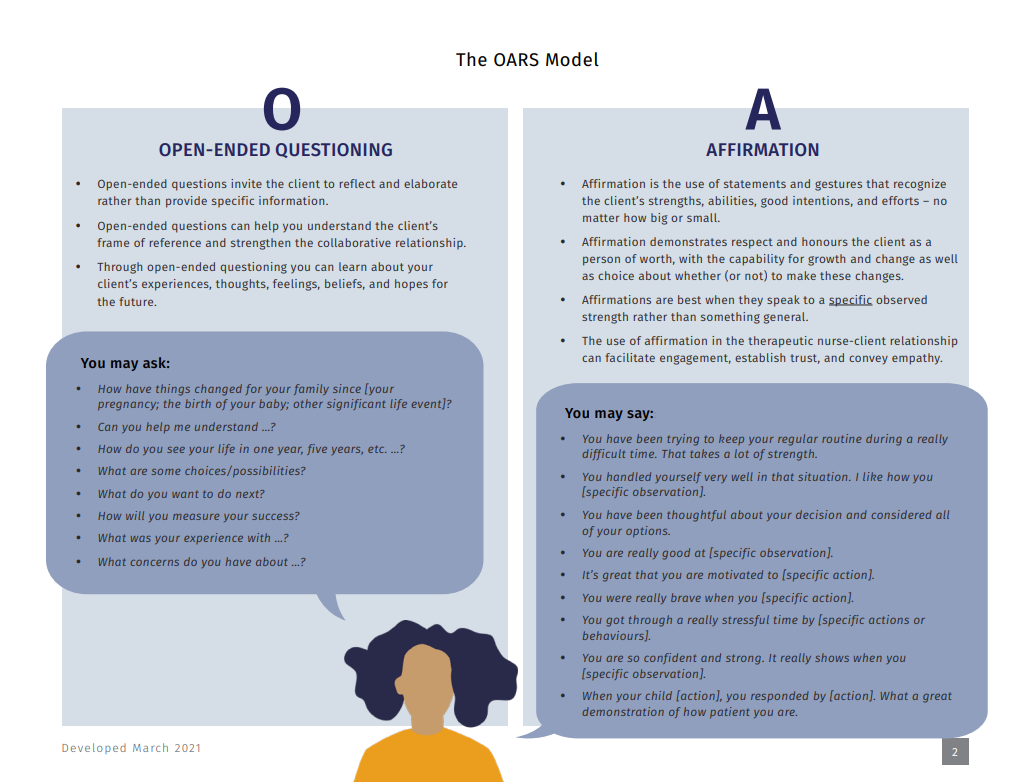
In this factsheet, Canada’s Public Health Nursing Practice, Research & Education Program (PHN-PREP) introduces the OARS model from motivational interviewing as a structured approach to active listening in healthcare.
OARS stands for Open-ended questioning, Affirmation, Reflective listening, and Summarising. It offers a clear, person-centred framework for building rapport, fostering emotionally safe interactions, and supporting client-led change. Rather than directing or correcting, OARS encourages clinicians to create space for people to speak in their own words, at their own pace.
So how does this link to stigma?
Without listening, we risk making assumptions. We may interrupt, minimise, correct, or unintentionally reinforce power imbalances. Stigma often emerges not in policies, but in moments: when someone feels dismissed, judged, rushed, or unheard.
Open-ended questions create space.
Affirmations acknowledge strengths and effort.
Reflective listening demonstrates understanding.
Summarising shows that what was said has been taken seriously.
Together, these practices reduce defensiveness and increase trust. They also make it more likely that someone will disclose concerns, experiences of discrimination, or barriers to care.
Active listening is not a soft skill. It is a stigma-reduction strategy.
By using structured listening techniques like OARS, healthcare professionals can interrupt subtle forms of interpersonal stigma and create conditions where people feel respected, safe, and understood.